

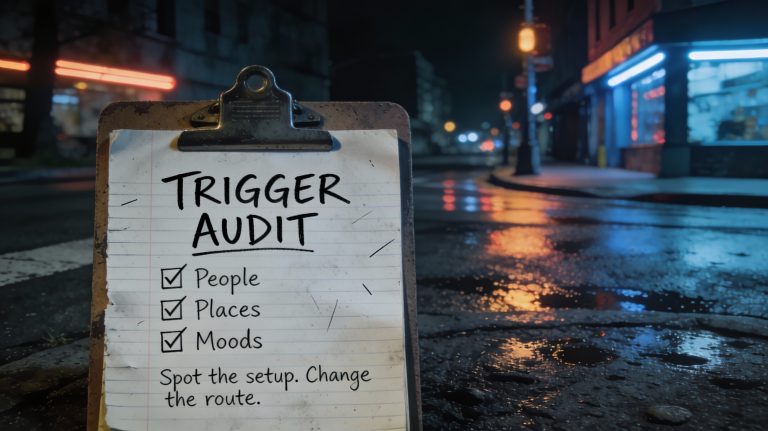
You don’t “randomly” relapse. You drift, you bargain, you take one “harmless” step, and then you act shocked when it turns into a full-blown mess. A trigger isn’t some mystical force—it’s a predictable setup that hits the same buttons every time.
This article is a trigger audit. Not a vibes check. Not a feelings essay. It’s a clean look at the people, places, and moods that quietly steer you toward the edge so you can stop acting like you didn’t see the cliff.
Inside
This Isn’t Paranoia — It’s Pattern Recognition
If you’re serious about sobriety, you don’t just avoid substances. You avoid the situations that make substances feel like a “good idea.” The relapse usually happens long before the drink or drug; it starts when you choose the conditions that make you fold.
A trigger audit is you getting honest about what sets you up, then building a plan that doesn’t depend on you being in a heroic mood. You’re not weak for having triggers. You’re reckless if you pretend you don’t.
What Counts as a Trigger (It’s Not Just a Bar)
Most people hear “trigger” and picture a liquor store or a party. That’s the obvious stuff, and yes, it matters. But the sneakier triggers are the ones that look normal—until you notice they keep ending the same way.
Here’s what counts:
- External triggers: people and places that pull you toward old versions of you
- Internal triggers: moods and body states that make you chase relief
- Combo triggers: the stack that really gets you (lonely + payday + certain friend = “somehow” you’re out)
If you only defend against the obvious stuff, the quiet stuff will smoke you.
The Three Buckets: People, Places, Moods
Think of your trigger audit like a security system. People are who can talk you into it. Places are where it’s easy to do it. Moods are when you’re most likely to say “screw it.”
The trap is pretending you can “handle it” now because you’ve had a few good days. Feeling better doesn’t mean you’re bulletproof. Sometimes feeling better is exactly when you start taking dumb risks.
People Triggers: Not Just the Obvious Clowns
Some people are clearly bad news. You already know who they are, and if you keep them close, you’re basically placing bets against your own sobriety. But the more dangerous people triggers are the ones who don’t look like triggers.
The obvious ones
- The party crew who only calls at night
- The “just one won’t hurt” friend
- The chaos magnet who turns every hangout into a story you regret
If they only like you when you’re self-destructing, they don’t like you. They like access.
The sneaky ones
- The “vent friend” who keeps you angry and stuck
- The guilt-tripper who punishes your boundaries
- The rescuer who wants you dependent, not stable
- The flirt or ex who triggers that old spiral: validation → adrenaline → bad decisions
These people don’t always hand you a drink. They hand you a mood that makes you want one.
People audit questions
Ask these, and don’t lie to yourself:
- After I see them, do I feel grounded—or do I feel spun up?
- Do I start hiding details, bending rules, or seeking permission?
- Do they respect “no,” or do they negotiate it?
- Do I feel like I need to recover from them afterward?
If someone consistently wrecks your nervous system, they’re not “just intense.” They’re a risk factor.
Place Triggers: Geography Has a Memory
Your body remembers. You can call it psychology, muscle memory, or straight-up conditioning, but it’s real. You walk into certain places and your brain starts playing the old soundtrack.
A place trigger isn’t only where you used. It’s anywhere your brain learned: “This is where we check out.”
High-risk locations
- Old using neighborhoods and routes
- Certain gas stations, parking lots, or “quick stop” corners
- Specific bars, clubs, house parties, and “chill” apartments
If you’re driving past your old spot “just because,” that’s not curiosity. That’s you warming up the engine.
Time-based danger zones
Some places become dangerous at certain times:
- Late nights when nobody’s watching you
- Weekends when boredom gets loud
- Payday when you feel rich and reckless
- Right after a fight when you want to punish yourself
Time is part of the trigger. Don’t ignore it.
Place audit questions
- What did I used to do here—and what do I pretend I won’t do now?
- What’s my exit plan if I get hit with cravings?
- Am I going there to handle business, or to flirt with trouble?
If you can’t clearly answer “why,” you’re not going for a reason. You’re going for a feeling.
Mood Triggers: The Inside Job
This is the part people hate, because you can’t “block” a mood like a phone number. But moods are often the real driver. Substances were never only about getting high; they were about getting different.
You’re not just auditing emotions. You’re auditing the moments you’re most likely to abandon your future for quick relief.
HALT: the basic check
HALT stands for hungry, angry, lonely, tired. This isn’t cute. This is the “stupid decisions starter pack.” If two or more are true, you’re not in a good place to make choices.
Before you trust your thoughts, handle your body:
- Eat
- Sleep
- Move
- Call someone safe
- Get out of isolation
The “good mood” trap
People relapse when they feel great, too. You get momentum, you feel proud, and then you start romanticizing the old life like it wasn’t a dumpster fire.
Good mood triggers look like:
- “I deserve it.”
- “I can handle it now.”
- “I proved I’m not like that anymore.”
That’s not confidence. That’s overconfidence—same thing that gets people hurt in real life.
The “bad mood” trap
Bad mood triggers are the classics:
- Shame: “I’m broken anyway.”
- Boredom: “I need something to happen.”
- Resentment: “Why do they get to be fine and I don’t?”
- Anxiety: “I can’t sit in my own skin.”
- Grief: “I need a break from reality.”
These moods don’t mean you should use. They mean you need a plan.
Mood audit questions
- What feeling makes me demand relief right now?
- What story do I start believing in that mood?
- What do I do right before the craving spikes (scrolling, isolating, driving, texting)?
The “first domino” matters more than the crash.
The Trigger Chain: How It Actually Goes Down
Relapse isn’t usually one choice. It’s a chain of small choices that feel harmless in the moment.
Here’s the honest version:
- Cue: you feel off, stressed, lonely, restless
- Thought: “I can’t keep doing this,” or “I deserve a break”
- Permission slip: “Just tonight,” “just one,” “just to take the edge off”
- Micro-moves: you stop answering calls, you go quiet, you “run an errand”
- Action: you’re in it
A gritty example:
- You fight with someone at home.
- You tell yourself you’re going for a drive to cool off.
- You drive the route you used to take.
- You text the person you “shouldn’t,” just to see if they’re around.
- Now you’re not managing a craving—you’re managing a situation you built.
Your job is to interrupt the chain earlier. Late-stage willpower is a bad strategy.
Do the 15-Minute Trigger Audit (No Journaling Olympics)
Set a timer for 15 minutes. You’re not writing a memoir. You’re identifying your repeat offenders.
Step 1: List your top triggers
Write three lists:
- 5 people
- 5 places
- 5 moods
Don’t overthink it. If a name pops up and you instantly get defensive, put it on the list.
Step 2: Rate each one for risk 1-10
Be honest, not aspirational. A “10” is “I usually fold here.” A “1” is “mild annoyance.”
If you rate everything a 3, you’re still in denial.
Step 3: Name your first domino
For each high-risk trigger, answer:
- What happens right before I start sliding?
Examples: I isolate, I skip meals, I stop going to meetings, I start scrolling exes, I drive with no destination.
First domino means earliest detectable sign, not the last stop before disaster.
Step 4: Pick one change for this week
One. Not ten. Not “be a new person.” One change you will actually do.
Good examples:
- “I’m not driving that route home this week.”
- “I’m blocking that number today.”
- “I’m eating breakfast before work, no exceptions.”
- “If I get lonely after 9 PM, I text a safe person instead of scrolling.”
Small changes with consistency beat big speeches.
Countermoves: Replace the Setup With Friction
Sobriety gets easier when using gets harder. You’re not trying to be strong; you’re trying to be smart.
- Cut access: delete numbers, leave group chats, stop “checking in,” avoid your danger routes
- Add friction: no late-night wandering, no “just stopping by,” no solo hangs with high-risk people
- Tighten structure: sleep, food, movement, a schedule that doesn’t leave you empty
- Build support: one or two people you can text when the craving hits, not after
If your plan relies on you “remembering your goals” in the middle of a spiral, your plan is trash.
A simple boundary script (use it verbatim)
“I’m not doing that anymore. Don’t ask me again.”
No debate. No explanation. Explanations invite negotiations.
If You Can’t Avoid the Trigger: Walk Through It Like You Mean It
Sometimes you can’t avoid the place or the person. Work, family, life happens. Fine. Then you don’t freestyle it.
Use a rule set:
- Arrive late, leave early
- Bring a safe person if possible
- Drive yourself so you can exit
- Keep a pre-written exit text ready: “Something came up. I gotta go.”
And do not stand around “testing yourself.” That’s ego. Ego gets you hurt.
The 120-second reset
Before you make any decision, do two minutes of something physical:
- Cold water on your face
- Fast walk outside
- Slow breathing: inhale 4 seconds, hold 4 seconds, exhale 6 seconds
You’re not trying to become Zen. You’re trying to interrupt the trance.
Track It for 7 Days (Data Beats Shame)
For one week, keep a quick log in your notes app:
- Trigger: person/place/mood
- Intensity 1-10
- What I did next
- Result 30 minutes later
This isn’t to judge yourself. It’s to catch patterns you keep “forgetting.” If the same trigger shows up three times, it’s not bad luck—it’s your system.
When Your Trigger Audit Says “Get Backup”
If your audit shows you’re getting hit hard every day, don’t romanticize suffering. Escalate support. That can mean therapy, outpatient, meetings, coaching, or medical help if withdrawal is part of your history.
Get help fast if you notice:
- repeated slips you keep hiding
- cravings that feel unmanageable most days
- risky behavior escalating (driving impaired, fights, disappearing)
- thoughts of self-harm or “what’s the point”
Tough love includes this truth: white-knuckling is not a recovery plan.
Use this as your baseline
Your trigger audit isn’t a one-time thing. It changes as your life changes. Run it again when you switch jobs, move, start dating, lose someone, or hit a major milestone.
You’re not trying to live scared. You’re trying to live awake.
Legit resources
- SAMHSA National Helpline: 1-800-662-HELP (4357) — free, confidential, 24/7/365 treatment referral and information for individuals and families; available in English and Spanish.
- FindTreatment.gov: a directory for finding treatment options in the U.S.
- If you’re in crisis or thinking about hurting yourself, call or text 988 (U.S.) for free, confidential, 24/7 support from the 988 Suicide & Crisis Lifeline.
Some links below are affiliate links—if you click and buy, this site may earn a small commission at no extra cost to you. It helps keep the lights on, and only services worth recommending get linked.
- Talkspace provides virtual therapy (and also offers psychiatry services on its platform), so support can happen from a phone or computer instead of an office visit.
- Online-Therapy.com is a CBT-focused online therapy platform that combines a self-guided program (sections + worksheets) with therapist support, including messaging and optional live sessions depending on subscription level.
- Brightside offers an online Intensive Outpatient Program (IOP) for substance use disorder, built around a weekly schedule that includes group therapy, individual therapy, and psychiatry/med consults as needed.
Keep Going
- Early Recovery Guide: Start Here (the “what to do in the first days/weeks” playbook).
- Detox vs Rehab vs IOP (What level of care is right for you?)
- First Meeting Guide (Nervous about your first meeting?)
- Craving Plan (Coming soon)
- Boundaries (Coming soon)
Newest Posts
- Amends: Not What You Say, Who You Become
- Wasted Years? Or The Moment You Finally Woke Up
- From Net Worth to Self-Worth: Why You’re Richer in Recovery Than You Think
- Detox vs Rehab vs IOP vs Sober Living: Understanding Levels of Care in Addiction Treatment (2026 Guide)
- Do I Need Rehab? A Raw Story of Survival and Recovery
