

Table of Contents
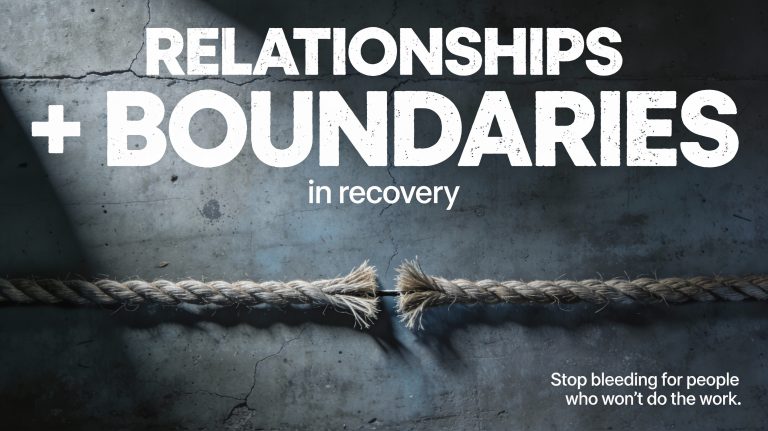
Boundaries aren’t “selfish.” They’re how you stay sober, stay sane, and stop letting other people’s chaos rent space in your nervous system. In recovery, relationships and boundaries either support the rebuild—or they become the slow leak that takes you out.
This is for both sides: the person in recovery who’s trying to stay upright, and the partner/parent/friend who’s exhausted from loving someone through lies, relapse, and broken promises.
Read this before you set a boundary
A boundary is not a rant. It’s not a threat. It’s not “You need to…”
It’s a line that says: Here’s what I will do. If you can’t enforce it, it’s not a boundary—it’s a wish.
- Boundary: “If you show up high/drunk, you can’t come in.”
- Not a boundary: “Please don’t ever do that again” (with no plan for what happens next).
- Boundary: “If you yell at me, I’m leaving the conversation.”
- Not a boundary: “You’re toxic and you always ruin everything.”
Why relationships and boundaries matter (when everything feels raw)
Early recovery is basically emotional rehab. Your brain is relearning how to cope without the old escape hatch. That means stress hits harder, shame hits faster, and drama feels like a craving with a voice.
Boundaries reduce relapse risk because they reduce chaos. They also reduce enabling because they stop the “rescue loop” where everyone plays their part and nobody heals.
What healthy boundaries look like (real-life examples)
Healthy boundaries are specific, boring, and repeatable. They don’t require a courtroom argument. They just require follow-through.
Healthy boundaries are specific because vague rules get twisted. “Be respectful” turns into a debate about tone, intent, and who started it. A real boundary names the exact behavior and the exact line: “If you show up drunk, you can’t come in,” or “If you raise your voice, I’m ending this call.” Clear language leaves less room for manipulation, bargaining, or confusion.
Healthy boundaries are boring because they’re not performances. They don’t come with speeches, receipts, or a closing argument. They don’t need you to prove you’re right. The point isn’t to win the relationship Olympics—the point is to protect your recovery, your nervous system, and your life. The calmer and simpler the boundary is, the harder it is for someone to hook you into drama.
Healthy boundaries are repeatable because people will test them—especially if your old pattern was folding. A boundary that only works when you feel confident isn’t a boundary, it’s a good mood. Repeatable means you can say it the same way on a good day and a bad day: one sentence, same limit, same next step. No new explanations. No fresh negotiations.
They don’t require a courtroom argument because you’re not trying to convince anyone you “deserve” basic respect. If someone needs a 30-minute debate to understand “don’t scream at me” or “don’t bring drugs into my house,” the problem isn’t your communication skills—the problem is that they want access without accountability.
They just require follow-through, because follow-through is what teaches people your limits are real. The first time you don’t enforce it, you train them to ignore it. The first time you do enforce it, you train yourself to trust you. And that’s the whole game in recovery: doing what you said you’d do, even when it’s uncomfortable, even when someone throws guilt at you, even when your body wants to cave just to make the tension stop.
If you’re in recovery
- “I’m not going to bars/house parties right now. If that’s the plan, I’m out.”
- “I’m protecting my sleep. I don’t do late-night drama. We can talk tomorrow.”
- “Don’t ask me to keep secrets for you. I’m done carrying other people’s mess.”
- “If you bring drugs/alcohol into my space, you’re not welcome here.”
- “If you insult me or scream, I’m leaving the conversation. Try again when you can talk like an adult.”
If you love someone in recovery
- “I love you. I won’t lie for you, call your boss, or cover your consequences.”
- “I won’t give cash. If you need food, I’ll order groceries.”
- “You can’t live here if you’re using. If you choose to use, you choose to leave.”
- “I’m not doing 2 AM emergency calls unless someone is in immediate danger.”
- “I’ll support treatment and recovery actions. I’m done funding destruction.”
The 4-line boundary formula (use this when you freeze)
If you grew up people-pleasing, you’ll want to overexplain. Don’t. Overexplaining invites negotiation. Keep it clean.
- Name the behavior (no insults): “When you show up drunk…”
- State the limit: “…I’m not letting you in.”
- State what you will do: “I will call you tomorrow when you’re sober.”
- Follow through: Do the thing. Calmly. Every time.
Scripts that don’t start wars
Use a neutral tone. No sarcasm. No “always/never.” You’re not trying to win—you’re trying to stop the bleeding.
- Privacy boundary: “I’m not discussing my recovery details. I’ll share what I’m comfortable sharing.”
- Time boundary: “I can do 15 minutes. After that I’m getting off the phone.”
- Conflict boundary: “If we’re yelling, we’re not communicating. I’m stepping away. We can talk at 6.”
- Money boundary: “I’m not giving cash. If you want help with essentials, send me a list.”
- Relapse boundary (loved ones): “If you use, you can’t be here. If you want help getting back into treatment, I’ll help with that.”
When they push back (because they will)
People who benefited from your lack of boundaries will call your boundaries “mean.” That doesn’t make them mean. It makes them inconvenient.
Expect guilt-trips, rage, bargaining, tears, silent treatment, and the classic: “So you don’t love me?”
You don’t argue. You repeat the line and follow through.
- Don’t debate: Boundaries aren’t a group project.
- Don’t explain forever: One sentence is enough.
- Don’t escalate: Calm is power.
- Don’t bluff: Only set consequences you can enforce.
Hard truth: boundaries reveal who’s safe
Safe people might not love your boundary, but they’ll respect it. Unsafe people will test it, punish you for it, or try to recruit others against you.
If someone repeatedly violates your boundaries, the problem isn’t your wording. The problem is access. And access is optional.
Mini action plan (do this today)
- Pick ONE boundary you’ve been avoiding.
- Write it in one sentence.
- Decide the consequence you will actually follow.
- Say it once, calmly.
- Follow through the first time it’s tested.
Build A Storm Shelter
- Love Under Siege: When Helping an Addict Starts Enabling Addiction
- Friends who still party: how to say no without the speech
- Dating in recovery: boundaries that protect your brain and your body
- Resentments in recovery and family: Stop over-giving before you relapse
- Stormborn Sobriety: Conflict Resolution in Recovery — 10 Rules That Protect Your Sobriety
- How Do I Help Someone Who Refuses Help
If The Storm Has Turned Bad
- SAMHSA National Helpline: 1-800-662-HELP (4357) — free, confidential, 24/7/365 treatment referral and information for individuals and families; available in English and Spanish.
- FindTreatment.gov: a directory for finding treatment options in the U.S.
- If you’re in crisis or thinking about hurting yourself, call or text 988 (U.S.) for free, confidential, 24/7 support from the 988 Suicide & Crisis Lifeline.
Some links below are affiliate links—if you click and buy, this site may earn a small commission at no extra cost to you. It helps keep the lights on, and only services worth recommending get linked.
- Talkspace provides virtual therapy (and also offers psychiatry services on its platform), so support can happen from a phone or computer instead of an office visit.
- Online-Therapy.com is a CBT-focused online therapy platform that combines a self-guided program (sections + worksheets) with therapist support, including messaging and optional live sessions depending on subscription level.
- Brightside offers an online Intensive Outpatient Program (IOP) for substance use disorder, built around a weekly schedule that includes group therapy, individual therapy, and psychiatry/med consults as needed.
From the Fires (Recent Posts)
- Amends: Not What You Say, Who You Become
- Wasted Years? Or The Moment You Finally Woke Up
- From Net Worth to Self-Worth: Why You’re Richer in Recovery Than You Think
- Detox vs Rehab vs IOP vs Sober Living: Understanding Levels of Care in Addiction Treatment (2026 Guide)
- Do I Need Rehab? A Raw Story of Survival and Recovery
