

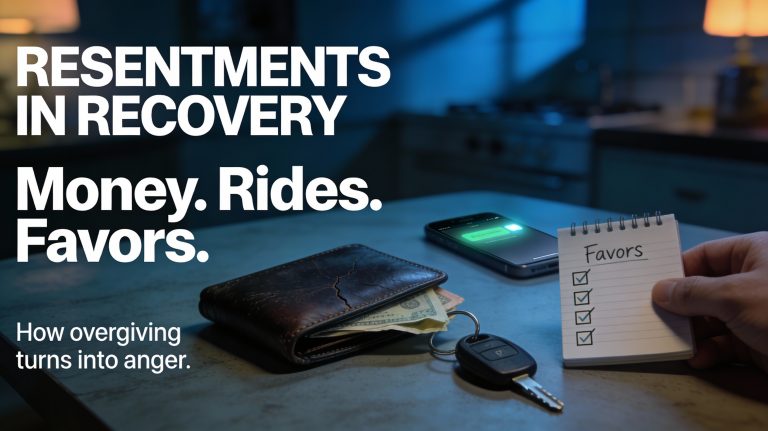
Recovery doesn’t just change who you are. It changes what people expect from you—and what you expect from them.
Most resentments in recovery aren’t born from some dramatic betrayal. They’re built like plaque: tiny deposits, day after day. Twenty dollars here. A ride there. “Can you call your sister and smooth this over?” “Can you come by and help with the kids?” “Can you spot me until Friday?” “Can you handle this one thing because you’re doing so much better now?”
None of it looks like abuse on paper. It looks like family. It looks like love.
And then one day you snap over something stupid—an empty gas tank, a late pickup, a “quick favor” that somehow becomes your whole weekend. You feel insane. Everyone else thinks you’re overreacting. You might even think you’re overreacting.
You’re not. You’re reacting to a long trail of unspoken deals, unpaid emotional invoices, and fake “yeses” you said because you didn’t know how to say “no” without feeling like a monster.
If you want the fastest way to build resentments—especially family resentments—mix recovery with money, rides, and favors, then add guilt. Shake well. Serve daily.
This is about how it happens, why it’s dangerous, and what to do before you end up drunk, high, or just plain hateful.
Why resentments hit harder in recovery
In active addiction, resentment is fuel. It’s a reason. A permission slip. “You don’t get me.” “They’re against me.” “I’m doing everything and nobody appreciates it.” You can always find a villain.
In recovery, resentments are worse because you’re awake for them.
You’re trying to build a different life—maybe for the first time. You’re learning emotional sobriety, which means you actually feel what you used to numb. You’re also trying to repair damage with family dynamics that were already messy before you got clean.
And here’s the twist: when you start doing better, people often decide you now have extra capacity. Extra time. Extra money. Extra emotional bandwidth. They may not say it that way, but they act like it. You become the designated problem-solver because you’re “stable now.”
That can feel like love at first: They trust me. I’m needed. I’m finally useful.
But usefulness without boundaries is a trap. It turns recovery into a second job where your paycheck is “thanks” (sometimes) and your benefits are anxiety and anger.
Resentments in recovery also carry a specific risk: they’re a relapse trigger. Not always in the obvious “I’m mad, I’m going to drink” way. More like:
- You start isolating because everyone feels like a demand.
- You start fantasizing about disappearing.
- You start telling yourself you deserve a reward.
- You stop doing the basics—meetings, calls, step work, therapy—because you’re busy rescuing other people.
- You start believing you’re trapped.
That cocktail has dropped a lot of people right back into old behaviors, even if the substance never comes back. Rage, manipulation, revenge spending, compulsive sex, binge eating, gambling, self-harm—resentment doesn’t care which coping mechanism you choose.
The unspoken contract: “I did this, so you owe me”
The seed of resentment is almost always an unspoken contract.
You give your brother rides to work and you never say: “I can do this twice a week, not daily.” You lend money and you never say: “If you don’t pay me back by Friday, I can’t help again.” You babysit and you never say: “I need a week’s notice and I can’t do overnight.”
So the other person writes their own contract in their head: Cool, this is available whenever I need it.
You write yours too: If I keep showing up, they’ll appreciate me. They’ll respect me. They’ll finally change. They’ll treat me like I matter.
Then reality happens. They don’t appreciate it the way you want. They don’t change. They keep asking. They act entitled. Or worse—they act like you’re lucky to help.
Now you’re not just tired; you’re offended. That’s resentment: anger with a story attached.
And here’s the part nobody likes admitting: sometimes we like these unspoken contracts because they let us avoid honesty. If you never say what you need, you can keep pretending you’re “fine,” while secretly collecting evidence that you’re being mistreated.
That evidence becomes your emotional stash. Your justification. Your future explosion.
Money: the cleanest way to contaminate relationships
In recovery, money is loaded. It’s not just dollars. It’s power, fear, shame, and history.
If you’ve ever stolen, lied, manipulated, or “borrowed” without returning, money is tied to your identity. Even if you’ve made amends, your nervous system remembers being broke, desperate, or reckless. So when money enters family relationships, it’s rarely a neutral transaction.
Here’s how money builds resentment fast:
- You give money you can’t afford because you’re trying to prove you’re not selfish anymore.
- You loan money to buy peace, to keep someone from getting mad, or to keep them close.
- You fund someone’s chaos, then hate them for staying chaotic.
- You overfunction financially because it makes you feel safe, needed, or “good.”
- You don’t say the terms, then resent the outcome.
Family resentments often come from one person becoming the unofficial bank. Maybe you’re the one who finally got a job, got stable, got credit, got a car. Suddenly, you’re a resource.
The line between support and enabling gets thin. Support helps someone grow. Enabling helps them stay the same while you pay the bill.
If you keep paying for someone’s irresponsibility, you’ll eventually hate them. Then you’ll hate yourself for hating them. Then you’ll hate recovery because “this is what being sober gets me.”
That’s a dangerous mental path.
If you need a gritty rule: if you can’t give the money as a gift with zero resentment, don’t call it a loan. And if you can’t afford to lose it, don’t hand it over.
Rides: the boundary killer disguised as kindness
Rides don’t seem like a big deal until they become your whole day.
A ride isn’t just a ride. It’s time, gas, wear on your car, your schedule, your nervous system. It’s also a power dynamic: the person without transportation is at the mercy of the person with it—unless they flip it and make you feel like you owe them for being “difficult.”
Rides are where people-pleasing goes to die.
Because the moment you say “I can’t,” you get hit with:
- “So you’re just going to leave me stranded?”
- “I thought you changed.”
- “You’re selfish.”
- “I would do it for you.”
And if you’re early in recovery—still shaky, still rebuilding trust—those words can slice deep. You may give the ride just to stop the guilt.
But every guilt-ride is a resentment deposit.
Rides become especially toxic in family dynamics in recovery when the person asking has a pattern of poor planning. They call last minute. They’re late. They “forget” to mention extra stops. They treat your time like it’s free because you’re “not doing anything.”
Here’s the truth: your recovery time counts as “doing something.” Meetings, sleep, gym, therapy, cooking, journaling, sponsor calls—those aren’t luxuries. They’re maintenance. Skip enough maintenance, and the machine breaks.
If someone repeatedly needs rides, the long-term solution isn’t you becoming their chauffeur. The solution is them building a plan: bus routes, bike, carpool, ride share budget, shifting work hours, saving for a beater car. If they refuse every solution that requires effort, what they want isn’t help. It’s access.
Favors: the slow poison of “Can you just…?”
Favors are where codependency and resentment shake hands.
Favors look like:
- “Can you talk to Dad for me?”
- “Can you come to court with me?”
- “Can you watch my kids while I ‘run errands’?”
- “Can you help me move again?”
- “Can you cover my shift?”
- “Can you deal with my consequences so I don’t have to?”
Favors become resentment when they’re one-directional or when they pull you away from your own life. And in recovery, you’re already rebuilding a life from scratch. You’re trying to form routines. You’re trying to become accountable. You’re trying to stop living in crisis.
So when someone else drags you into their crisis, it doesn’t just annoy you. It threatens your foundation.
There’s another reason favors create resentments in recovery: they can become a new addiction. The “helper high.”
If you grew up in dysfunction, you might not know who you are without being needed. If you got sober and felt empty, being the family fixer can feel like purpose. Until it doesn’t.
Then you feel used. But you also feel guilty for feeling used. So you keep doing it. That’s how resentment becomes a lifestyle.
The family roles don’t disappear when you get sober
Families have roles: the hero, the scapegoat, the clown, the lost child, the caretaker. Addiction can lock those roles in place for decades.
When you get into recovery, you might think you’re leaving your old role behind. But families don’t update the script that fast. Sometimes they’ll try to shove you back into it—consciously or not.
If you were the “mess,” they might keep treating you like you’re one bad day away from relapse. They might micromanage you, test you, or withhold trust long after you’ve changed.
If you become the “success story,” they might use you as proof that others should be able to get it together too. They may push you to rescue siblings or take on responsibility you didn’t sign up for.
If you were the caretaker before addiction, you may slide right back into caretaking as soon as you’re stable, because it’s familiar.
Any of those patterns can generate family resentments. And resentment isn’t always loud. Sometimes it’s a quiet shift: you stop answering calls quickly, you start making excuses, you dread holidays, you fantasize about cutting everyone off.
You don’t have to cut everyone off to have boundaries. But you do have to stop pretending your “yes” is love when it’s really fear.
Support vs enabling: the line that saves your sanity
This line matters in recovery, because people will accuse you of “not being supportive” the moment you stop overextending.
Support sounds like:
- “I’ll help you look up resources.”
- “I can give you a ride to the appointment you scheduled.”
- “I can watch the kids for two hours while you go to your meeting.”
- “I can loan you $50 once, and that’s it.”
Enabling sounds like:
- “I’ll pay the bill again so you don’t get shut off.”
- “I’ll lie to Mom and tell her you were with me.”
- “I’ll drive you everywhere because you refuse to plan.”
- “I’ll clean up this mess so you don’t feel discomfort.”
Discomfort is not abuse. Consequences are not cruelty. If you remove every consequence from someone’s life, you become the consequence.
And you will resent them for it.
The resentment warning signs (before you blow)
Most people wait until the explosion. The goal is to catch it earlier.
Watch for these signs:
- You say yes and immediately feel angry.
- You keep score in your head: “After everything I’ve done…”
- You rehearse arguments in the shower or in traffic.
- You feel your stomach drop when their name pops up.
- You avoid them, then feel guilty, then overcompensate.
- You start using sarcasm, sighs, or passive-aggressive “jokes.”
That’s your inner truth trying to get your attention. If you ignore it long enough, it will come out sideways—at your partner, your kids, your sponsor, your job, or yourself.
Why “just say no” isn’t enough
People love giving simple advice: “Set boundaries.” As if boundaries are a switch you flip.
In reality, boundaries in recovery are hard because they poke at deep stuff:
- Fear of abandonment.
- Fear of conflict.
- Shame about the past.
- The need to prove you’re changed.
- Trauma bonding with family members.
- Religious or cultural expectations about loyalty.
- The belief that love means sacrifice.
Also, some families punish boundaries. The moment you set one, the temperature changes. People sulk. They gossip. They call you selfish. They bring up your past: “After what you put us through…”
That’s when you find out if your boundary is real or just a suggestion.
A real boundary isn’t a debate. It’s information about what you will do.
Not: “Please don’t ask me for rides anymore.”
But: “I’m not available for rides. If you ask, the answer will be no.”
Not: “I need you to pay me back.”
But: “I’m not lending money anymore. If you need resources, I can help you find some.”
Scripts you can actually use (without sounding like a therapist)
You don’t need fancy language. You need clean, direct sentences and the willingness to be uncomfortable.
Try these:
- “I can’t do that.”
- “That doesn’t work for me.”
- “I can do X, but I can’t do Y.”
- “If it’s last minute, the answer is no.”
- “I’m not lending money. I can help you brainstorm options.”
- “I’m focusing on my recovery right now.”
- “I’m not available for rides. Please plan another way.”
If they push, repeat yourself. Don’t explain. Explanations turn into negotiations, and negotiations turn into resentment.
A useful rule: give one sentence of context, then stop. The more you talk, the more openings you create for manipulation, guilt, or argument.
What if you already built the resentment?
If you’re already deep in it—already feeling used, already hating the sound of their voice—you’re not doomed. But you need to clean it up before it poisons you.
- Own your part without blaming yourself.
Did you say yes when you meant no? Did you avoid stating terms? Did you secretly hope they’d change because you helped? That’s not a moral failure; it’s a skill gap. - Stop the leak immediately.
If money is the issue, stop lending. If rides are the issue, stop driving. If favors are the issue, pause them. You can’t “process” resentment while continuing the behavior that creates it. - Tell the truth, cleanly.
Not a rant. Not a speech. A boundary. “I’ve been overextending, and I’m not doing that anymore.” - Expect backlash.
People who benefited from your lack of boundaries will not clap when you get healthy. - Get support outside the family.
Sponsor, therapist, meetings, Al‑Anon, CODA, trusted friends. Family systems tend to pull you back into old roles. You need outside gravity. - Do a reality check: are you being exploited?
Some people aren’t just “needy.” They’re manipulative. If you set a basic boundary and they retaliate, that’s information.
The part nobody wants to hear: resentment is often self-abandonment
Yes, other people can be inconsiderate. Yes, families can be brutal. Yes, some relatives will milk you until you’re dry.
And also: resentment often marks the spot where you left yourself.
You abandoned your time. Your budget. Your sleep. Your recovery routines. Your right to say no. You traded self-respect for approval or peace.
That’s why resentment feels so hot. It’s not just anger at them. It’s anger at you for betraying you.
The fix isn’t becoming cold or selfish. The fix is becoming honest.
Honesty sounds like: “I love you, but I’m not doing that.” Or sometimes just: “No.”
How to help without building a resentment bill
If you want a practical way to stay generous without turning into a volcano, use these guardrails:
- Give from surplus, not from panic.
- Decide your limits before you’re asked.
- Put conditions in writing if money is involved.
- Trade “rescues” for “support” (resources, info, encouragement, one-time help).
- Leave room for your own life and recovery routines.
- If you feel resentful, treat it like a check-engine light, not a personality flaw.
Recovery isn’t just about not using. It’s about building a life you don’t need to escape from.
And you cannot build that life while being everyone’s wallet, chauffeur, and cleanup crew—especially if you’re doing it with clenched teeth and a fake smile.
Money, rides, and favors aren’t bad. But doing them without boundaries is how you turn love into leverage and help into hate.
If you want to stay sober—and stay sane—stop signing invisible contracts. Say what you can do. Say what you won’t do. Let people feel whatever they feel about it.
Your job is not to be liked. Your job is to be free.
Storm Shelter
- Early Recovery Guide – Start here (Our Foundation)
- Relapse Prevention Plan (because when rebuilding, stress is real).
- Boundaries (we need protection, not walls)
- Rebuilding Life After Addiction (built upon our foundation)
When the Storm Turns Bad
- SAMHSA National Helpline: 1-800-662-HELP (4357) — free, confidential, 24/7/365 treatment referral and information for individuals and families; available in English and Spanish.
- FindTreatment.gov: a directory for finding treatment options in the U.S.
- If you’re in crisis or thinking about hurting yourself, call or text 988 (U.S.) for free, confidential, 24/7 support from the 988 Suicide & Crisis Lifeline.
Some links below are affiliate links—if you click and buy, this site may earn a small commission at no extra cost to you. It helps keep the lights on, and only services worth recommending get linked.
- Talkspace provides virtual therapy (and also offers psychiatry services on its platform), so support can happen from a phone or computer instead of an office visit.
- Online-Therapy.com is a CBT-focused online therapy platform that combines a self-guided program (sections + worksheets) with therapist support, including messaging and optional live sessions depending on subscription level.
- Brightside offers an online Intensive Outpatient Program (IOP) for substance use disorder, built around a weekly schedule that includes group therapy, individual therapy, and psychiatry/med consults as needed.
From the Fire (Latest Posts)
- Amends: Not What You Say, Who You Become
- Wasted Years? Or The Moment You Finally Woke Up
- From Net Worth to Self-Worth: Why You’re Richer in Recovery Than You Think
- Detox vs Rehab vs IOP vs Sober Living: Understanding Levels of Care in Addiction Treatment (2026 Guide)
- Do I Need Rehab? A Raw Story of Survival and Recovery
