
Table of Contents
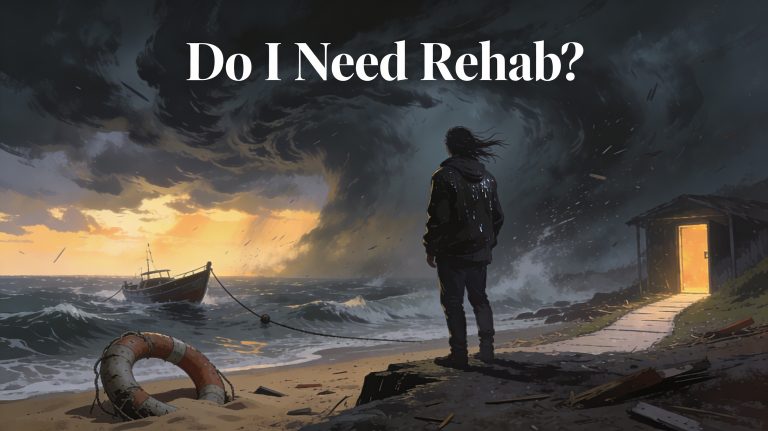
There’s a moment that most of us in the storm reach — that soft, dangerous question that won’t leave us alone: Do I need rehab?
It doesn’t always come at rock bottom. Sometimes it shows up in the in-betweens — when you’ve lost just enough to feel it, but not enough to stop. For me, it came early in my relapse. I wanted to get clean, but the thought of stepping away, of facing the silence without a crutch, terrified me. Rehab sounded like losing everything, when in reality, I had already lost almost all of it.
I kept using. Kept chasing comfort that never came. I was surviving the storm — homeless through hurricanes, living off FEMA hotel vouchers, selling just to maintain a high. I wasn’t eating right, barely sleeping, showering when I could. I called it survival, but it wasn’t living. It was sinking slower than I wanted to admit.
The question we avoid
The hardest thing about addiction isn’t always quitting; sometimes it’s admitting we can’t do it alone. We tell ourselves stories — I’ve got this, I just need to slow down, I’ll fix it when things calm down. But things never calm down. The storm doesn’t stop because we want it to. It stops when we finally stop fighting the idea of surrender.
I fought that idea for a long time. I thought rehab meant weakness. That it meant I had failed. But the truth is, rehab isn’t about weakness — it’s about finally getting strong enough to face yourself without the mask.
Surviving the storm
During that stretch, my life was pure chaos. I wasn’t just using; I was selling too, thinking I had it all figured out — street-smart, numb, performing control. I saw myself as “one of the tough ones.” Looking back now, that toughness was just survival mode dressed up as pride.
The people around me were just as lost. We used each other to survive — trading, hustling, pretending we were free when we were all bound by the same chains. That’s the thing about that kind of darkness: it convinces you that the chaos is home.
The breaking point
Then came January 9th, 2025 — the day my father passed away. I wasn’t there in the way I should have been. That guilt destroyed me. It cracked something deep inside, something I had buried for too long. I started saying the quiet thing out loud — I can’t do this anymore.
The night before I was arrested, I said those exact words to someone. Hours later, six sheriffs showed up. I call that my “divine interception.” Because that night, the universe made a choice I couldn’t.
The war within
In the county jail, I kept wrestling with the same question: Do I need rehab? I wanted to believe I could do it on my own, that I could white-knuckle my way out of the storm like I always did. But history had already answered that question for me — every time I tried to fix it myself, I ended up right back where I started.
This time, I knew something had to change. I had to do things differently. Otherwise, I’d just rinse and repeat the same disaster.
What rehab really gave me
Rehab wasn’t what I expected. It wasn’t punishment. It wasn’t a cage. It was the first real quiet I’d had in years. No drugs. No chaos. No constant survival mode. Just time — to breathe, to think, to heal.
It forced me to look inward, past the surface excuses, past the storms I’d blamed everything on. I started learning the roots of my pain instead of feeding them. Rehab gave me a place to rebuild, piece by piece, until I could stand again.
It didn’t fix everything — nothing that real happens overnight — but it gave me the shelter to anchor myself. The storm quieted, not because it was gone, but because I finally learned how to stand still inside it.
If you’re asking, you probably already know
So if you’re out there wondering, Do I need rehab? — maybe ask yourself this: has what you’re doing stopped working? Have you lost more than you can even tally in words? Are you just surviving?
If so, you already know. The answer’s been sitting in your gut, waiting for you to listen.
Rehab isn’t giving up; it’s showing up. It’s standing in the wreckage and saying, I’m still here. I want to live again. Because surviving the storm is one thing — but learning to walk out of it, that’s Stormborn. That’s where the real sobriety begins.
Build Your Storm Shelter
- Early Recovery Guide – Start here (Our Foundation)
- Relapse Prevention Plan (because when rebuilding, stress is real).
- Boundaries (we need protection, not walls)
- Rebuilding Life After Addiction (built upon our foundation)
If the Storm Has Turned Bad
- SAMHSA National Helpline: 1-800-662-HELP (4357) — free, confidential, 24/7/365 treatment referral and information for individuals and families; available in English and Spanish.
- FindTreatment.gov: a directory for finding treatment options in the U.S.
- If you’re in crisis or thinking about hurting yourself, call or text 988 (U.S.) for free, confidential, 24/7 support from the 988 Suicide & Crisis Lifeline.
Some links below are affiliate links—if you click and buy, this site may earn a small commission at no extra cost to you. It helps keep the lights on, and only services worth recommending get linked.
- Talkspace provides virtual therapy (and also offers psychiatry services on its platform), so support can happen from a phone or computer instead of an office visit.
- Online-Therapy.com is a CBT-focused online therapy platform that combines a self-guided program (sections + worksheets) with therapist support, including messaging and optional live sessions depending on subscription level.
- Brightside offers an online Intensive Outpatient Program (IOP) for substance use disorder, built around a weekly schedule that includes group therapy, individual therapy, and psychiatry/med consults as needed.
Stormfront Dispatches
- Amends: Not What You Say, Who You Become
- Wasted Years? Or The Moment You Finally Woke Up
- From Net Worth to Self-Worth: Why You’re Richer in Recovery Than You Think
- Detox vs Rehab vs IOP vs Sober Living: Understanding Levels of Care in Addiction Treatment (2026 Guide)
- Do I Need Rehab? A Raw Story of Survival and Recovery
