


Table of Contents
We of stormborn sobriety know the chaos we have sown across every facet of our lives. From the streets to the bedroom, we brought conflict like weather—unannounced, violent, and somehow always “justified.” We learned how to win arguments the way addicts win: by any means necessary. Twist the facts. Raise the volume. Weaponize vulnerability. Make them the villain so we can keep being the victim.
Then we get clean and expect a parade.
We think there should be horns announcing our arrival. I’m cured. I’m different now. Do the peasants not see this? I say it in jest, but the delusion is real: we forget that while we were busy destroying ourselves, other people were living our addiction through us. They carried it. They adapted to it. They got cut by it. And when we step into sobriety, we often bring the same combat style—just with better vocabulary.
Recovery doesn’t automatically give you conflict resolution skills. Sobriety gives you the chance to build them. And if you don’t, fights become one of the easiest back doors back to the old life—because resentment is a drug, righteousness is a drug, and “I’ll show you” has relapsed more people than a Friday night.
This is a gritty guide for the ones trying to stay clean and stay connected. Not perfect. Not soft. Just real rules for conflict that won’t torch your progress.
The point of fighting fair
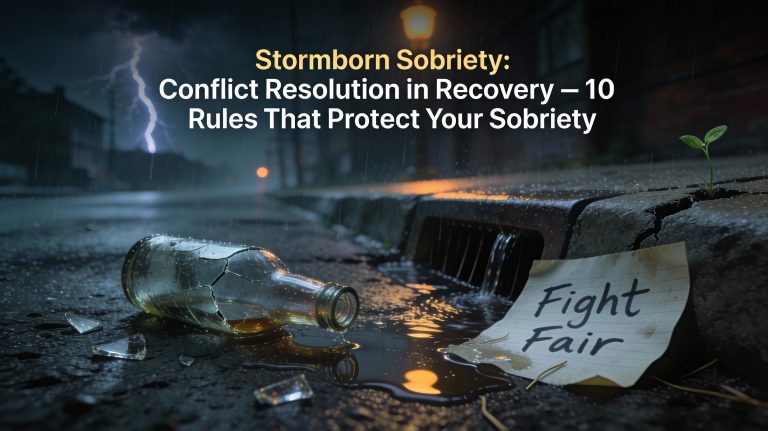
The goal isn’t to “win.” Winning is what addicts do—stack the bodies, take the territory, call it survival.
The goal is to tell the truth without becoming cruel.
The goal is to leave the conversation with your dignity intact, their dignity intact, and your sobriety intact. If your “honesty” requires humiliation, intimidation, or punishment, it’s not honesty. It’s a hit.
10 Rules of Conflict Resolution in Recovery
Rule 1: Don’t fight to discharge pain
A lot of us confuse communication with emotional dumping. We feel pressure in the chest, heat in the throat, and we aim it at the nearest person like a release valve.
If you’re fighting because you can’t stand what you’re feeling, you’re not seeking resolution—you’re seeking relief. That’s relapse energy in a suit.
Say it out loud if you need to:
- “I’m activated.”
- “I’m not thinking clearly.”
- “I want to hurt you right now and I don’t want to be that person.”
That’s not weakness. That’s leadership.
Rule 2: No threats, no ultimatums, no hostage situations
Threats are emotional extortion. Ultimatums are just threats in cleaner packaging. “If you loved me you would…” is a hostage note.
In recovery, we don’t build safety by cornering people. We build safety by being predictable.
If you need a boundary, state it like a grown adult:
- “If yelling starts, I will leave the room and we can try again later.”
- “I’m willing to talk, but not if we’re insulting each other.”
A boundary is about what you will do. A threat is about what you’ll do to them.
Rule 3: No character assassination
Addiction taught us to go for the throat: “You’re selfish.” “You’re a liar.” “You always do this.” “You never change.” That’s not conflict. That’s a demolition.
Fight the behavior, not the identity.
Try this translation:
- “You’re selfish” becomes “When you made that choice without talking to me, I felt invisible.”
- “You never change” becomes “I’m scared this pattern is back.”
If you label someone, they’ll defend the label. If you describe the impact, you give them something they can actually respond to.
Rule 4: Stay out of the past unless it’s the pattern
We love dragging up old crimes because it gives us ammunition and removes responsibility from the present. It’s also how we turn one problem into a whole courtroom.
If the past matters, name why:
- “I’m bringing this up because it’s the same pattern, and I need to know it’s changing.”
If it’s not the pattern—if it’s just revenge—drop it. Revenge feels like power, but it rots you from the inside.
Rule 5: Don’t argue while flooded
There’s a moment where your nervous system takes the wheel. Your hearing narrows. Your mind turns into a weapon. Your body thinks it’s in danger. Logic is gone. Empathy is gone. You can still speak words, but you’re basically on a drug.
That’s the moment you pause, not push.
Call a timeout before you become someone you’ll have to make amends for:
- “I need 20 minutes.”
- “I’m too heated to do this right.”
- “I’m coming back, I’m not abandoning you.”
The commitment to return matters. The timeout without return is just avoidance wearing recovery clothes.
Rule 6: Don’t use recovery as a weapon
This one is ugly because it looks “spiritual.”
- “You’re being triggered.”
- “You’re in your disease.”
- “That’s your trauma talking.”
- “My sponsor says…”
Maybe it’s true. Doesn’t matter. If you use it to win, it becomes manipulation with a halo.
Talk about you:
- “I’m noticing I’m defensive.”
- “I’m scared I’m slipping into old patterns.”
- “I need to take responsibility for my side.”
Recovery is a tool for humility, not a club for dominance.
Rule 7: One fight at a time
Addicts love escalation. It’s how we turn a dish in the sink into a referendum on the entire relationship.
Pick one topic. Stay on it. If another issue is real, write it down and schedule it.
Say:
- “That’s important. Can we finish this one first?”
- “Let’s list the other issues and choose one to handle tonight.”
You’re not sweeping it under the rug—you’re refusing to burn the house down.
Rule 8: Validate before you explain
Most fights don’t end because the “facts” get settled. They end because somebody finally feels seen.
Validation isn’t agreement. Validation is saying, “Your experience makes sense.”
Try:
- “I can see why that hit you.”
- “If I were you, I’d probably feel the same.”
- “I get that this scared you.”
Then explain your side. Explanations before validation sound like excuses. Validation before explanation sounds like care.
Rule 9: Repair fast, even if you weren’t perfect
In addiction, we were experts at rupture and amateurs at repair. We’d blow things up, disappear, come back like nothing happened, then get angry that people didn’t “move on.”
Repair is not groveling. It’s accountability.
A clean repair sounds like:
- “I raised my voice. That was wrong.”
- “I used sarcasm to punish you. I’m sorry.”
- “Next time I’m flooded, I’m taking a timeout instead of swinging.”
And if you don’t know what to do next time, say that too. Honesty is better than pretending.
Rule 10: Protect sobriety like it’s oxygen
If the conflict is pushing you toward relapse thinking—revenge fantasies, “I don’t care anymore,” “I deserve a break,” “I’ll show them”—you treat that like a medical emergency.
Do the unsexy survival stuff:
- Call someone safe (sponsor, friend in recovery, therapist)
- Eat something
- Drink water
- Move your body
- Get out of the room
- Pray if you pray
- Write the real truth (not the courtroom version)
You can come back to the issue. You can’t always come back from the drink/drug/behavior that “helped” you cope.
When the other person fights dirty
Fighting fair doesn’t mean you accept abuse. Some people are not safe to conflict with. Some people use conflict as control. Some people want you dysregulated because it makes you easier to manipulate.
If they won’t stop yelling, name-calling, threatening, or violating boundaries, you don’t “communicate harder.” You create distance and get support. Recovery isn’t staying in the fire to prove you’re strong.
The Stormborn Promise
We don’t become safe overnight. We become safe by practicing safety.
Every time you pause instead of pounce, you’re rewriting the nervous system. Every time you admit fault without collapsing into shame, you’re growing up emotionally. Every time you repair, you’re breaking a generational pattern—inside you and around you.
You don’t need horns announcing your sobriety.
You need consistency. You need humility. You need rules you follow even when you’re angry—especially when you’re angry.
Because the real flex isn’t winning the fight.
The real flex is staying clean and staying human.
Build A Storm Shelter
- Early Recovery Guide – Start here (Our Foundation)
- Relapse Prevention Plan (because when rebuilding, stress is real).
- Boundaries (we need protection, not walls)
- Rebuilding Life After Addiction (built upon our foundation)
If the Storm Has Turned Bad
- SAMHSA National Helpline: 1-800-662-HELP (4357) — free, confidential, 24/7/365 treatment referral and information for individuals and families; available in English and Spanish.
- FindTreatment.gov: a directory for finding treatment options in the U.S.
- If you’re in crisis or thinking about hurting yourself, call or text 988 (U.S.) for free, confidential, 24/7 support from the 988 Suicide & Crisis Lifeline.
Some links below are affiliate links—if you click and buy, this site may earn a small commission at no extra cost to you. It helps keep the lights on, and only services worth recommending get linked.
- Talkspace provides virtual therapy (and also offers psychiatry services on its platform), so support can happen from a phone or computer instead of an office visit.
- Online-Therapy.com is a CBT-focused online therapy platform that combines a self-guided program (sections + worksheets) with therapist support, including messaging and optional live sessions depending on subscription level.
- Brightside offers an online Intensive Outpatient Program (IOP) for substance use disorder, built around a weekly schedule that includes group therapy, individual therapy, and psychiatry/med consults as needed.
