


Table of Contents
The Addict Identity That Defined Me
When we first come into recovery, we know who we are in the middle of an identity crisis in recovery. We are intimately aware of the struggles we have faced, the lengths that we have gone to attain our drug of choice. We know what we have done to others in our addictions. Our identities get deeply rooted in our using—that addict identity becomes our entire world. Our addictions, while they may start out slow, end up dictating to us who we are. We allow our lives to become unmanageable.
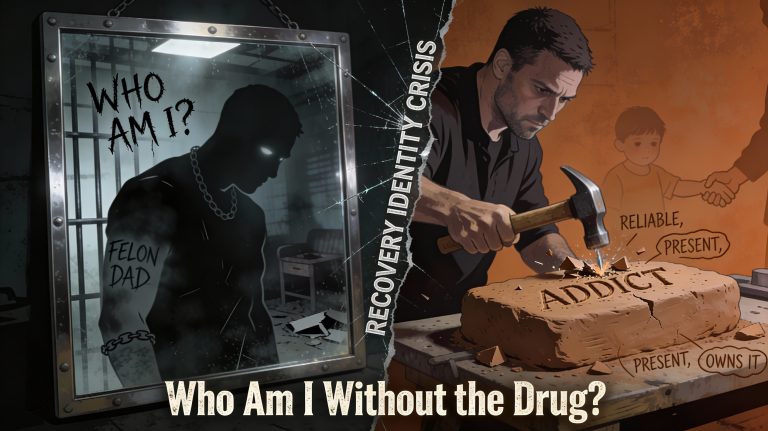
Somewhere in that unmanageable mess, we stop seeing ourselves as anything else. I remember during this time, I didn’t take a deep look in the mirror. Even living out of hotel rooms, I barely glanced. Afraid of what I would see. I remember, after landing in jail, staring in that polished steel mirror and not fully recognizing myself—but knowing deep down this was “me” now. I had become the guy who would steal from his own family to get another bag. The one who’d lie to his own mother about where the rent money went. Who sold drugs, knowing the potential fallout that it could cause, just to keep the highs going. That recovery identity crisis didn’t hit until I put the drugs down, but looking back, it started the first time I chose the drug over a promise.
Losing Myself to the Drug
We are no longer the individuals that we were prior to our using. We aren’t even the same individual that we were at the early days when it was still just fun and social. Somewhere along the way, things start to go a little sideways. We lower our standards just a little bit more. As time carries on, our using picks up and we further lose our idea of self to the identity crisis in active addiction—the drug becomes the boss telling us who we are now.
That slow erosion? It creeps up until you’re not even pretending anymore. For me, “fun and social” turned into solo hotel benders, chasing the same high that used to come easy. Friends faded, replaced by whoever had a connect. I’d wake up promising “today’s different,” but by noon, the drug had rewritten the script: skip work, dodge calls, hit the trap house.
That identity crisis wasn’t some big crash—it was death by a thousand small surrenders, each one chipping away at who I used to be until nothing clean remained. Looking back, that’s when the real chains locked in.
How My Environment Shaped the Change
Often our environments drastically change. We change the people that we are willing to hang out with. We become much more selfish in our pursuit of the next high. Many of us addicts will feel like these changes just happened. We can’t always point to an exact time and place that these changes occurred, just one day we wake up and they are what they are. Identity thus changed, we may carry on in active addiction for some time the best that we can. Making our identity crisis all that much more difficult to change.
For me, it was trading family dinners for trap house blasts. The mother of my children calls went unanswered while I crashed with runners who didn’t ask questions. Work buddies? Ghosted for dope boys who kept the supply flowing.
That selfishness wasn’t a choice—it was survival mode, where the high trumped every bond. One day you’re the reliable guy; next, you’re the ghost everyone whispers about. For me, my relapse? That was the dramatic line in the sand after all the gradual poison. That addict identity owned the room, and I let it redecorate with wreckage.
The Sobriety Void Hits Hard
When we come to recovery, whether by jails, detoxes, treatment centers, the rooms of a 12-step program, or even just trying to “white knuckle” it, we come to understand that we no longer know ourselves. That identity crisis in recovery slams the door shut on the only “me” we’d known for years.
No more highs to define the day. No rituals, no chases, no escape hatches. Just you, raw, staring at emotional walls that used to hold bags or pipes. For me, it was the county lockup silence after the detox fog—nothing but regret echoes and “who the hell am I without this?” pounding my skull. The white knuckler pretends they got this, but inside? Blank slate terror.
That addict identity was the devil you knew; sobriety rips it away, leaving a stranger in the mirror who doesn’t even want to fight for rent, kids, or air. We grasp for old labels, but they crumble too. This void? It’s where the real recovery identity crisis kicks in hard.
My Jail Cell Identity Crisis
For me, my first two weeks was a flood of emotion, mostly regret and shame for the pain and hurt that I had caused my two sons and their mother. For that short period of time, my identity was solely rooted in that of an addict detoxing in a county jail. I identified as a waste of an individual, just another common criminal. No future, just a dreg upon society that puts drugs before their family. I would go on to battle with identity for some time to come.
That cell became my identity mirror—polished steel mirror reflecting a hollowed-out shell who’d pawned everything that mattered. “Felon dad” looped in my head louder than the lockdown buzzer. No high to numb it, just wave after wave of “what have I done?” crashing until I couldn’t breathe. Compounded regrets of my father’s passing mere weeks before, “how horrible of a son I was to not be there”.
I’d pace those 8×10 feet, bargaining with ghosts: “If I get out, I’ll be better.” But deep down? I was still that guy, chains invisible now. The battle wasn’t just physical or mental detox; it was wrestling that addict identity screaming “this is forever.” Every family phone call just dug the hole deeper, proving I didn’t deserve the air I was breathing.
Why Identity in Recovery Sets You Free
It has only been recently that I have started to understand how mutable identity can really be. How limiting it truly can be, but also how much it can set you free. That is why our identity in recovery becomes so important. In early recovery it is difficult as we don’t always know exactly what we want our identity to be. However, I think that we look too deeply into the idea of “identity”.
We chase some perfect “recovered me” like it’s a finish line, but that’s the trap. Identity isn’t a tattoo—it’s clay we smash and reshape daily. For me, it clicked post-jail, sitting in a mandated Department of Corrections long-term treatment center, wondering “who signs this?” Not the felon, not the ghost dad, but some hybrid fighting for air.
That recovery identity crisis morphed when I stopped labeling and started acting; show up one group session at a time, keep one promise to my ex and my children. Freedom hit not from answers, but from realizing the question “who am I?” powers the rebuild. No guru needed—just raw choices cutting through the old chains. I could be another forced participant of a flailing system or take active interest in who I wanted to become.
Ditch Labels, Embody Traits
Our identity is better served, in my opinion, by being rooted not in an ideology that is set in stone. Such as…I am an addict, a father, a son, an employee, a felon, or any other label with which we put upon identity. Our identities are better served by seeking to embody the positive traits of who we wish to become.
Labels lock us in concrete; traits let us build. “Felon” doesn’t have to mean failure forever if I show up reliable. “Addict” fades when integrity replaces the chase. For me, it was ditching “just a dad who failed” for traits like “present”–one call at a time, no excuses. Learning to listen to their needs over my own. No need to declare “I’m recovered”; just act like the man who keeps his word, owns his wreckage, fights for family. That shift? Recovery identity crisis flips to power when traits trump titles. We become what we do daily, not what we were stuck being.
Reflection: Rebuild from Addict Behaviors to Mentors
We get stuck in our addiction following certain behaviours that suit the usage of our chosen drugs. We sell dope to make money for our own dope. We rob to get our drugs. We hurt those close to us who try and stop us from using our desired drugs.
We get so involved in that identity that we emotionally shut down to who we really are. We cause ourselves trauma by denying who we really are.

Overcoming Identity Crisis in Recovery
However, this is where reflection can give us a jump start into figuring out who we are and who we want to become. First take a few minutes to yourself. Calm your mind and your fears, we’re not going to do an exhaustive inventory like we would if we were doing the 4th step of a 12-step program (though that’s not near as bad as many would think). Think back, and try to do this emotionally neutral, just a fact-finding mission here folks. Think back about the behaviours that constituted the identity that was crafted by our addiction. Here we can see attributes that we no longer wish to embody.
My Addict Traits I Ditched:
- Family thief → Stealing from sons/mom for bags
- Ghost promises → No-shows, unanswered calls
- Dope desperation → Dealing to chase highs
- Selfish survival → High > every bond
Mentor Traits I Stole:
- Reliable (sponsor) → Rain or shine meetings
- Forgiving (ex) → Fought for kids despite wreckage
- Owns it (old-timer) → Felon past, no excuses
Daily Action: Pick 1 ditch + 1 steal today. One call. One truth. Mirror changes.
Take a big more time and think of two to three people that you highly respect. These will be what I call, today’s mental mentors. What we want to think about isn’t how much money they make, what property they own or don’t own.
We want to think about their behaviours that led us to think of them with respect. Do they show up on time? Keep their word? What do they do that allows us to identify them with respect?
By looking at these attributes in such a way, we can start to see where we need to change the direction we have taken. We can, as well, the attributes that we would like to start to embody ourselves. And that, for me, has helped me to rebuild my identity in recovery.
My addict behaviours list? Stealing from family, ghosting promises, dope-dealing desperation. Mentors? My sponsor who showed up rain or shine; ex who kept fighting for our kids despite my wreckage; that old-timer who owned his felon past without excuses.
Their traits—reliability, forgiveness, brutal honesty—gave me targets. Started small: one on-time call, one owned lie. Day by day, those recovery identity pieces clicked. No magic, just stealing better habits until the mirror showed progress.
Daily Choices: Your Power to Become
I am not a counsellor, I hold no certificates, I’m no coach, nor therapist, or Doctor. What I am is an addict that has struggled with finding who they were once the drugs were put down. I didn’t want to be just an addict. But I also realized, I’m not just a dad. Or just an entrepreneur. Not just the homeless guy that I once was.
These are all pieces of the overall makeup of my individuality that combines to make my identity. I have concluded, for myself, that I get the choice to become who I want to be. The more I act in accordance with that image in my mind of who I am, the more I become that individual.
Each New Day
Each day brings us choices about who and what we are. In recovery, this may be doubly so. As many of our choices had become chains where no option lies. Now, we are sober and we have a choice. We get to keep deciding for ourselves each day, as long as we remain clean and sober. And that is the power of our journey. To be who we are meant to be. Who I mean for me to be. Who you mean for yourself to be. We are only limited by the limitations we place upon our own necks.
I am grateful for this opportunity to each day discover a new piece of the puzzle that is me. To further define and grow my identity in recovery. Remember, this is only my opinion as the result of the road my recovery has taken. If you are thinking about quitting drugs and alcohol, I fully recommend you seek help. If you have already quit and are dealing with questions of identity, feel free to reach out to me and I will do my best to provide any assistance I can.
Need Help Now?
SAMHSA (Substance Abuse and Mental Health Services Administration) Free confidential treatment referral + crisis support
National Helpline: 1-800-662-HELP (4357) (24/7) | English/Español
Text your zip code to 435748 (HELP4U)
Online Chat: samhsa.gov/find-help
Every morning’s a vote: old chains or new traits? I choose showing up—for kids, my recovery, for me. Some days I stumble, but the mirror shows a man building, not breaking. That recovery identity crisis? Fuel now, not chains.
