

Inside
If you’re here, it’s probably not on a good day. It’s on a “my life is leaking out through the cracks” day—money, trust, health, sleep, sanity.
This isn’t a pep talk. This is triage: pick the right level of care so you don’t white-knuckle for three days, relapse on day four, and call it “proof you’re broken.”
Editorial note (read this first): This article is educational and based on lived experience plus public clinical guidance. It is not medical advice and it can’t replace an assessment by a licensed clinician.
Source backbone: Detox definitions and the “detox isn’t treatment by itself” point are grounded in SAMHSA TIP 45, which defines detoxification as interventions to manage acute intoxication and withdrawal and states detox alone is not sufficient in the treatment and rehabilitation of substance use disorders.
What detox is supposed to include: TIP 45 describes detox as a process with three components—evaluation, stabilization, and fostering entry into treatment—and says detox without all three is “incomplete and inadequate.”
Get help fast: If you feel unsafe or might hurt yourself, call/text/chat 988 or 988lifeline.org.
If you need help finding treatment options (detox/inpatient/PHP/IOP), SAMHSA’s National Helpline is 1-800-662-HELP (4357) (free, confidential, 24/7/365; English/Spanish).
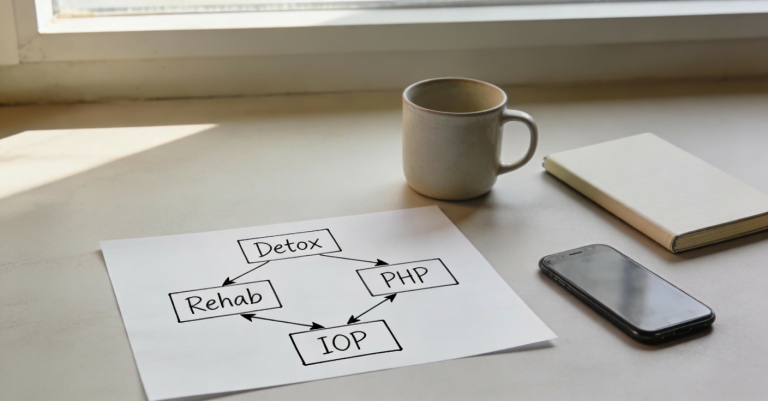
Detox vs Rehab vs PHP vs IOP: The 30-second definitions (no brochure language)
- Detox / Withdrawal management: Interventions aimed at managing acute intoxication and withdrawal—getting you cleared out and stabilized.
- Rehab (residential/inpatient): You live there so your environment can’t keep reaching into your life and yanking you back.
- PHP (Partial Hospitalization Program): High-structure treatment during the day (often most weekdays) and you go home at night.
- IOP (Intensive Outpatient Program): Structured treatment multiple days per week while you live at home.
The sentence that matters: SAMHSA TIP 45 says detoxification alone is not sufficient treatment/rehabilitation.
Detox: the moment your body collects its debt
Detox is a set of interventions aimed at managing acute intoxication and withdrawal—clearing toxins while trying to minimize physical harm. TIP 45 says detox is supposed to include evaluation, stabilization, and fostering entry into treatment, and it calls detox without all three “incomplete and inadequate.”
The detox-only trap (where hope goes to die)
Withdrawal can feel like the whole war because it’s loud and personal. But TIP 45 is blunt: detoxification alone isn’t sufficient treatment/rehabilitation—it’s one part of a continuum of care. If detox ends with you back in the same house, the same phone, the same triggers, then detox wasn’t a plan—it was an intermission before the next relapse.
What to ask any detox (so you don’t get dumped):
- “What’s the step-down plan after detox—rehab, PHP, IOP, outpatient?”
- “Will that next step be scheduled before I leave?”
- “How do you link patients into ongoing treatment once they’re stable?”
Rehab: when home is the trigger
Rehab usually means you live at the program, which creates distance from access and triggers. TIP 45 describes detox as the “first door” and emphasizes linking people into treatment immediately after detoxification, which is why rehab is a common next step when home equals relapse.
Rehab is the honest move when:
- Going home tonight means you’ll use.
- Your living situation is soaked in chaos, conflict, or active use.
- You keep trying “outpatient + willpower” and you keep disappearing.
- You need 24/7 structure because your brain is not safe with the keys right now.
PHP: heavy structure, sleep at home
PHP is treatment with serious daytime structure (often most of the day, most weekdays), but you go home at night. PHP can be a step-down from residential or a step-up from IOP when you need more hours, more contact, and more accountability without living onsite.
PHP works best when:
- Nights at home won’t immediately turn into relapse.
- You need daily structure because your mood and cravings are volatile.
- Weekly therapy is nowhere near enough.
PHP struggles when:
- Nights are where you use.
- Home is unsafe, unstable, or actively triggering.
IOP: recovery while real life still touches you
IOP is structured treatment multiple days a week while you live at home. It’s for people who need more than “good luck and a meeting,” but can stay physically safe outside residential.
IOP is a strong fit when:
- You can reliably attend sessions.
- You have at least one safe person or safe place.
- You need accountability because your private brain is a liar.
IOP is usually not enough when:
- Your home is an active using environment.
- You’re relapsing constantly and hiding it.
- You’re trying to stop without an assessment and withdrawal risk is high.
Comparison table (plain talk)
| Option | Where you live | Main goal | Big limitation |
| Detox | Setting varies by need | Manage acute withdrawal and stabilize; link into treatment. | TIP 45 says detox alone isn’t sufficient treatment/rehabilitation. |
| Rehab | You live there | Remove you from triggers + build structure | Needs a step-down plan after discharge (PHP/IOP/outpatient/support) |
| PHP | Home at night | High structure without residential | Nights can wreck you if home is triggering |
| IOP | Home | Structured support while rebuilding life | Not enough if home is unsafe or relapse is constant |
Quick decision tree (brutal, useful, fast)
Answer like you’re under oath:
- “If I stop, could I get medically unsafe—or do I not know?”
If yes/unsure → start with an assessment for detox/withdrawal management.
- “If I go home tonight, will I use?”
If yes → rehab/residential is the straight answer.
- “If I go home tonight, will I be safe but miserable?”
If yes → PHP or IOP depending on how much structure you need.
- “Do I have a next-step plan after detox?”
If no → you’re walking into the detox-only trap TIP 45 warns about (detox is incomplete without evaluation + stabilization + entry into treatment).
The lie your brain tells at each level of care
Addiction is a professional liar. It doesn’t kick down the door—it picks the lock and speaks in your own voice.
Detox lie: “If I can just get through withdrawal, I’m good.”
Truth: TIP 45 says detoxification alone isn’t sufficient treatment/rehabilitation, and it frames detox as evaluation + stabilization + entry into treatment.
Rehab lie: “I don’t need rehab. I just need discipline.”
Truth: if home is the trigger, “discipline” is not a plan—it’s a dare.
PHP lie: “I can handle nights.”
Truth: nights are where the old life sneaks back in through your boredom, loneliness, anxiety, and one stupid text.
IOP lie: “I’ll go… once life calms down.”
Truth: life doesn’t calm down because you asked nicely.
Bonus lie (common to all): “If I need more help, I’m weak.”
Truth: needing structure usually means you finally stopped lying about the size of the problem.
Red flags (how people get hurt)
- “Detox is all you need.” TIP 45 directly says detoxification alone isn’t sufficient treatment/rehabilitation.
- No next-step handoff. TIP 45 describes detox as including entry into treatment and calls detox incomplete without evaluation + stabilization + that linkage.
- Pressure + vagueness. If they dodge basic questions or rush you to sign, that’s not care—it’s sales.
- Miracle language. “Guaranteed cure” should hit your brain like a fire alarm.
Scripts (steal these)
Script: calling a program
“Hi. I’m trying to stop using. I need an assessment for the right level of care—detox, residential, PHP, or IOP. I’m not looking for detox-only with no follow-up plan.”
Script: calling a safe person
“I’m trying to stop. I’m scared and I’m not safe alone. Can you stay with me or stay on the phone while I get help lined up?”
Script: when shame shows up
“I’m not asking for permission to be sick. I’m asking for help to get better.”
FAQ (My Honest Opinion)
Is detox enough?
Detox can get you stabilized, but it usually doesn’t touch the reasons you use or the environment that feeds it. TIP 45 says detoxification alone is not sufficient treatment/rehabilitation, and it frames detox as a process that should include evaluation, stabilization, and fostering entry into treatment—without that linkage, it’s incomplete.
What if I can’t afford treatment?
Say it out loud anyway. SAMHSA’s National Helpline (1-800-662-HELP / 4357) is free, confidential, available 24/7/365, and provides treatment referral and information (English/Spanish).
What if I can’t leave work, kids, school, or court/probation stuff?
That’s not an excuse—that’s real life, and real life is where relapse hides. PHP and IOP exist because not everyone can disappear into residential, but you still might need serious structure to stay alive.
I did detox before and relapsed right after. Does that mean I’m hopeless?
No. It often means you did the “stop the bleeding” part and never got the full continuum TIP 45 stresses—detox is supposed to lead into ongoing treatment, because detox alone isn’t sufficient treatment.
I’m not “bad enough” for rehab, right?
Addiction loves that line because it buys time. Rehab isn’t a trophy you earn by suffering—it’s a tool you use when home is a relapse machine.
What’s the fastest legit way to find treatment?
SAMHSA’s National Helpline is 1-800-662-HELP (4357) (free, confidential, 24/7/365; English/Spanish). If you feel unsafe or might hurt yourself, call/text/chat 988 right now.
Help finding treatment (fast, legit)
SAMHSA’s National Helpline is a free, confidential, 24/7, 365-day-a-year treatment referral and information service (English/Spanish): 1-800-662-HELP (4357).
(more options coming soon)
Keep Going
- Start Here: /early-recovery-guide
- Withdrawal fear: /withdrawal-fear (coming soon)
- Day 0–1: /day-0-1
- Slip / used again: /slip
- First meeting guide: /first-meeting-guide (coming soon)
